CALGARY, Alberta, Dec. 04, 2025 (GLOBE NEWSWIRE) -- Integral Metals Corp. (CSE: INTG | FSE: ZK9) (the “Company” or “Integral”) is pleased to announce assay results from the seven diamond drill holes completed during the 2025 program at the KAP Project in the Mackenzie Mountains, Northwest Territories, Canada. Drilling successfully confirmed the presence of zinc (Zn) mineralization with associated gallium (Ga) and germanium (Ge) enrichment within sphalerite-bearing breccia horizons.
Highlights
- Hole KAP-25-001B tested the Central Zone of the Main Showing and intersected 17.72% Zn, 228 ppm Ga, and 294 ppm Ge over 5.60 m, including a high-grade core of 28.26% Zn, 362 ppm Ga, and 473 ppm Ge over 3.45 m, verifying historical shallow mineralization in the Central Zone.
- Hole KAP-25-002 tested the Central Zone and returned 14.27% Zn, 215 ppm Ga, and 159 ppm Ge over 5.00 m, including 1.20 m of 21.10% Zn, 382 ppm Ga, and 363 ppm Ge.
- Hole KAP-25-005 tested the North Zone extension of the Main Showing and returned 4.57% Zn, 68 ppm Ga, and 87 ppm Ge over 9.40 m, validating the historical step-out from the Central Zone.
- Hole KAP-25-006 tested the furthest North Zone step-out and delivered 8.28% Zn, 61 ppm Ga, and 80 ppm Ge over 16.15 m, representing one of the broadest Zn-Ga-Ge intervals drilled to date and confirming expansion potential in the North Zone beyond historical limits.
All reported intervals are apparent thicknesses; true widths have not yet been determined.
Detailed intervals are provided in Table 1, and a summary of collar coordinates are provided in Table 2.
Program Summary
The 2025 drill program was designed to (1) verify historical zinc intercepts at the core of the Central Zone of the Main Showing, (2) test a northerly extension in the North Zone of the Main Showing, (3) evaluate the distribution of gallium and germanium within zinc-bearing sphalerite, and (4) test structural and stratigraphic controls along the Manetoe-style carbonate platform. A total of seven NQ-sized diamond drill holes (KAP-25-001A to KAP-25-006) were completed across 843 meters. Holes 001A, 001B, 002, and 003 targeted the Central Zone, while holes 004, 005, and 006 tested northerly extensions in the North Zone.
The program successfully reproduced high-grade Zn, Ga, and Ge mineralization documented in historical work, and expanded across the Central Zone; step-out drilling demonstrated that mineralization continues north-northwest of historical hole F96-05, validating and enlarging the collapse breccia corridor in the North Zone; multi-element assays clarified the distribution of gallium and germanium within sphalerite across the system; and new geological observations, including collapse breccias, recrystallization fronts, and permeability contrasts within the Manetoe and Landry formations, have refined the structural and stratigraphic controls guiding ongoing exploration. Collectively, the textures, geochemistry, and vertical and lateral variations observed in the recent drill core support an emerging hybrid MVT and Carbonate Replace Deposit (CRD) model, where earlier basinal-brine mineralization is locally overprinted and upgraded by hotter, metal-rich hydrothermal fluids, improving both the grade profile and exploration potential of the system.
Drill Hole Results
KAP-25-001A (Main Showing; Central Zone): The first hole of the program was collared in the Central Zone of the Main Showing, and intersected mineralization starting near the surface, from 8.00 m to 10.00 m (2.00 m), which averaged 29.58% Zn, 245 ppm Ga, and 397 ppm Ge. The casing was sunk into strongly mineralized dolostone, which resulted in partial core loss through an approximately 1-meter-thick zone of semi-massive sphalerite-galena breccia. Following poor recovery while first setting the HQ casing, the hole was re-collared at a shallower dip and then completed to 12.35 m using NQ casing. The recovered core showed coarse, honey-brown sphalerite within dolomite breccia and cross-cutting carbonate veinlets, confirming historically observed near-surface mineralization at the Central Zone of the Main Showing.
KAP-25-001B (Main Showing; Central Zone): Collared on the same pad as KAP-25-001A, the hole was drilled to 86 meters, and successfully intersected mineralization from 12.70 m to 18.30 m (5.60 m), which averaged 17.72% Zn, 228 ppm Ga, and 294 ppm Ge, including 3.45 m (from 12.70 m to 16.15 m) averaging 28.26% Zn, 362 ppm Ga, and 473 ppm Ge. The interval consisted of semi-massive, honey-brown sphalerite with minor galena hosted within the upper Manetoe facies breccia. Recovery was excellent, confirming the mineralized horizon previously observed in KAP-25-001A. Beneath the mineralized zone, dolostone displayed strong brecciation and veining, indicating active fluid movement and hydrothermal fracturing along the contact between the Landry and Arnica units. These features support a model where mineralization was fed by ascending basinal brines exploiting dissolution and porosity zones, consistent with an MVT system.
KAP-25-002 (Main Showing; Central Zone): Collared on the same pad as KAP-25-001A, this hole was drilled to 50 meters to test the lateral continuity of the upper Manetoe facies, and it successfully intersected two zones of variable sphalerite mineralization from 3.15 m to 8.50 m (5.35 m) averaging 13.33% Zn, 73 ppm Ga, and 126 ppm Ge; and from 10.50 m to 15.50 m (5.00 m) averaging 14.27% Zn, 215 ppm Ga, and 159 ppm Ge. The intervals were comprised of disseminated to semi-massive sphalerite within recrystallized dolostone, interbedded with bitumen- and silica-rich horizons. Veining, brecciation, and pervasive dolomite recrystallization indicated active fluid movement along a dissolution front near the Manetoe-Arnica contact. Compared to KAP-25-001B, the mineralization in this hole was more diffuse, suggesting variability at a local scale, reflecting the space available for mineral deposition. The abundance of re-crystallized silica and black bitumen implied repeated fluid influx and local remobilization of zinc, gallium, and germanium during late-stage hydrothermal activity.
KAP-25-003 (Main Showing; Central Zone): Collared on the same pad as KAP-25-001A, this hole was drilled to 66 meters, and successfully intersected mineralization between 15.00 m to 17.10 m (2.10 m) in banded and locally semi-massive sphalerite mineralization which averaged 16.46% Zn, 103 ppm Ga, and 247 ppm Ge. The interval exhibited alternating light and dark bands of dolomite, silica, and sphalerite, with local bitumen and stylolitic textures indicating cyclic fluid pulses. Compared to previous holes, the mineralization appeared weaker and more restricted as reduced brecciation and less intense silica flooding imply diminished hydrothermal fluid flow.
KAP-25-004 (Main Showing; North Zone): Collared on a new pad in the North Zone of the Main Showing, located approximately 240 m north-northwest of the first pad, this hole was designed to re-test the geometry and continuity of the collapse breccia zone first intersected in historical drill hole F96-05. Drilled to a total depth of 200 m, this hole intersected a wide zone of variable sphalerite mineralization between 93.65 m and 169.60 m, which included intermittent intercepts such as from 146.16 m to 154.00 m (7.85 m) which averaged 2.23% Zn, 39 ppm Ga, and 38 ppm Ge. Broadly, the zone was characterized by banded, brecciated, and colloform textures typical of an MVT system. The mineralization occurred within a collapse breccia developed at the top of the Manetoe Formation, where recrystallized dolostone fragments were found to be cemented by dolomite and sphalerite. Locally, there were narrow semi-massive bands of sphalerite were accompanied by galena and minor marcasite, often associated with stylolitic dolomite and late calcite veining. The hole supports a dome-like geometry of the mineralized breccia complex, and validated historical interpretations of structural collapse and fluid pooling within a karst-controlled trap. The broad intersection confirms observations from historical hole F96-05, in that mineralization extends beyond the Central Zone of the Main Showing, continuing beneath a shallow plateau area that remains open along strike.
KAP-25-005 (Main Showing; North Zone): Collared on the same pad as KAP-25-004, this hole was drilled to 203 meters, and was designed to continue testing the north-northwest continuity of the collapse breccia system, and to verify the up-dip extent of the mineralized horizon intersected in historical hole F96-05. The hole successfully intersected multiple intervals of mineralization between 62.20 m to 166.50 m, which included elevated intercepts from 142.00 m to 151.40 m (9.40 m) which averaged 4.57% Zn, 68 ppm Ga, and 87 ppm Ge; and, from 164.35 m to 166.50 m (2.15 m) which averaged 4.23% Zn, 83 ppm Ga, and 62 ppm Ge. The intervals were characterized by disseminated and replacement sphalerite with subordinate galena within recrystallized dolostone and limestone. The mineralized zones commonly occurred near the contact between limestone and dolomitized breccia, where coarse calcite-sphalerite-galena veining suggests renewed hydrothermal fluid access along permeability contrasts. The presence of coliform sphalerite and galena in calspar veins supports a late, low-temperature mineralizing event consistent with an MVT overprint on an earlier breccia framework.
The results from KAP-25-005 confirmed continuity of Zn-Ga-Ge-bearing collapse breccia mineralization stepping out to the north-northwest from the Central Zone, and validated the structural model proposed from earlier drilling. The hole demonstrated that the mineralizing system remains open along strike beneath the plateau area, where fluid pathways appear to have focused within limestone-dolostone transitions. This success guided the positioning of KAP-25-006 farther along trend to test for thicker, higher-grade mineralized zones within the same breccia corridor.
KAP-25-006 (Main Showing; North Zone): Collared on the same pad as KAP-25-004, the final hole of the program was drilled to 224 meters as the furthest step-out from the Central Zone of the Main Showing, targeting the projected continuation of the collapse breccia corridor. The hole successfully intersected broad zones of sphalerite mineralization from 61.30 m to 205.85 m, which included colloform and replacement sphalerite within recrystallized dolostone that was intermittently mineralized. Notably elevated zones were observed at 132.00 m to 137.50 m (5.50 m) which averaged 5.11% Zn, 23 ppm Ga, and 41 ppm Ge; and, at 182.20 m to 198.35 m (16.15 m) which averaged 8.28% Zn, 61 ppm Ga, and 80 ppm Ge. The mineralization occurred as replacement and banded sphalerite within collapse breccia and dolostone, locally with galena, and was accompanied by pervasive dolomite recrystallization and late calcite veining.
The hole KAP-25-006 represents an important step in confirming the north-northwest extension of the mineralized system from the Central Zone, expanding the known footprint of the Main Showing beyond the limits of historical drilling. The presence of multiple stacked mineralized zones, including lenses not seen in historical drilling, with dense colloform sphalerite bands suggests repeated fluid influx events and preservation of open fluid pathways within the breccia network. The density and continuity of sphalerite replacement textures make this hole perhaps the most significant of the program, validating the hypothesis that mineralization continues and remains open in a north-northwest-trending structural corridor beyond the Central Zone.
“The results of this year’s drilling confirms that KAP hosts a zinc-rich system with strong gallium and germanium co-enrichment,” said Paul Sparkes, CEO of Integral Metals. “We’ve successfully reproduced historical zinc mineralization while demonstrating associated gallium and germanium in the host rock, and we find this to be a compelling combination for both critical-metal exposure and near-term exploration growth.”
Next Steps
The Company plans to model the results of this program to continue understanding the subsurface context of the mineralization. Select samples may be submitted for mineralogical analysis, to quantify and evaluate the host minerals of zinc, gallium and germanium at the Main Showing.
Qualified Person Statement
Scientific and technical information in this news release has been reviewed and approved by Integral Metals’ Vice-President of Exploration, Jared Suchan, Ph.D., P.Geo. (NWT #L5387), a Qualified Person as defined under Canadian National Instrument 43-101.
Data Verification
All geological and geotechnical data generated during the 2025 KAP drilling program were collected under a formal quality assurance and quality control (QA/QC) framework consistent with industry best practice. NQ-sized core was recovered from all seven drill holes, with core recoveries typically exceeding 90% in mineralized intervals. Following retrieval from the drill, core was washed, structurally and geologically logged, photographed, and marked for sampling at the on-site field facility.
Sampling intervals were selected on geological boundaries and did not exceed 1.5 meters in length; sample lengths of 1.5 meters or less were consistently applied through mineralized zones to better capture grade variability. Drill core was cut lengthwise using a diamond-blade core saw, with half-core submitted for laboratory analysis and the remaining half retained on site for reference. Sample shipments were securely sealed and transported under chain-of-custody procedures from the project site to the preparation laboratory.
A QA/QC program was implemented that included the systematic insertion of certified reference materials (standards) andcoarse blanks (hardware store limestone or OREAS blank)into the sample stream at approximate rates of 5% each. QA/QC results were reviewed by the Company upon receipt of the analytical dataset, and no material issues or failures were identified in the performance of standards and blanks.
All samples were prepared and analyzed by ALS Geochemistry, an independent ISO/IEC 17025-accredited laboratory. All samples underwent standard preparation at ALS, including received sample weights (WEI-21), barcode logging (LOG-23), crushing quality control tests (CRU-QC), pulverizing QC tests (PUL-QC), and sample logging (LOG-21). Samples were finely crushed to 70% passing <2 mm (CRU-31), split using a riffle splitter (SPL-21), and pulverized up to 250 g to 85% passing <75 µm (PUL-31). Routine multi-element analyses were performed using the ME-MS89L method, a sodium peroxide fusion with ICP-MS finish designed for ultra-trace gallium, germanium, and associated pathfinder elements. Samples returning elevated zinc were automatically flagged by ALS for additional over-limit analysis (FND-02). Over-limit zinc was analyzed using Zn-OG62 (four-acid digestion with ICP-AES finish). Very high-grade zinc samples were further re-run using Zn-VOL50, a titration-based zinc assay recommended for ore-grade material. Additional supporting geochemistry, including a four-acid 34-element suite, was completed using ME-ICP61.
For a further discussion of the Company’s QA/QC and data verification procedures and processes, please see the technical report entitled, Technical Report on the KAP Property, Mackenzie Mountains, Northwest Territories, Canada, a copy of which may be obtained under the Company’s profile at www.sedarplus.ca.
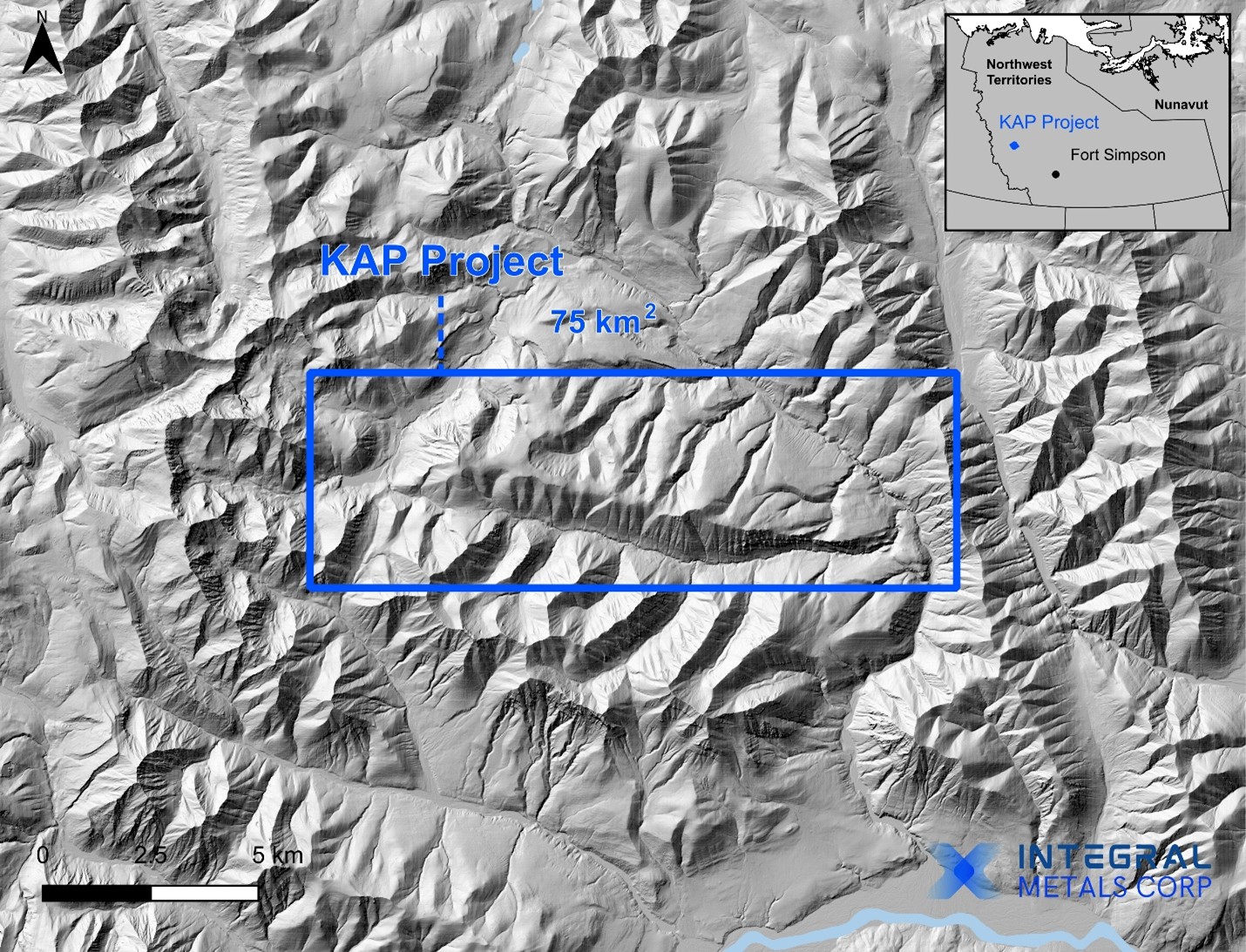
Figure 1: KAP Project location.
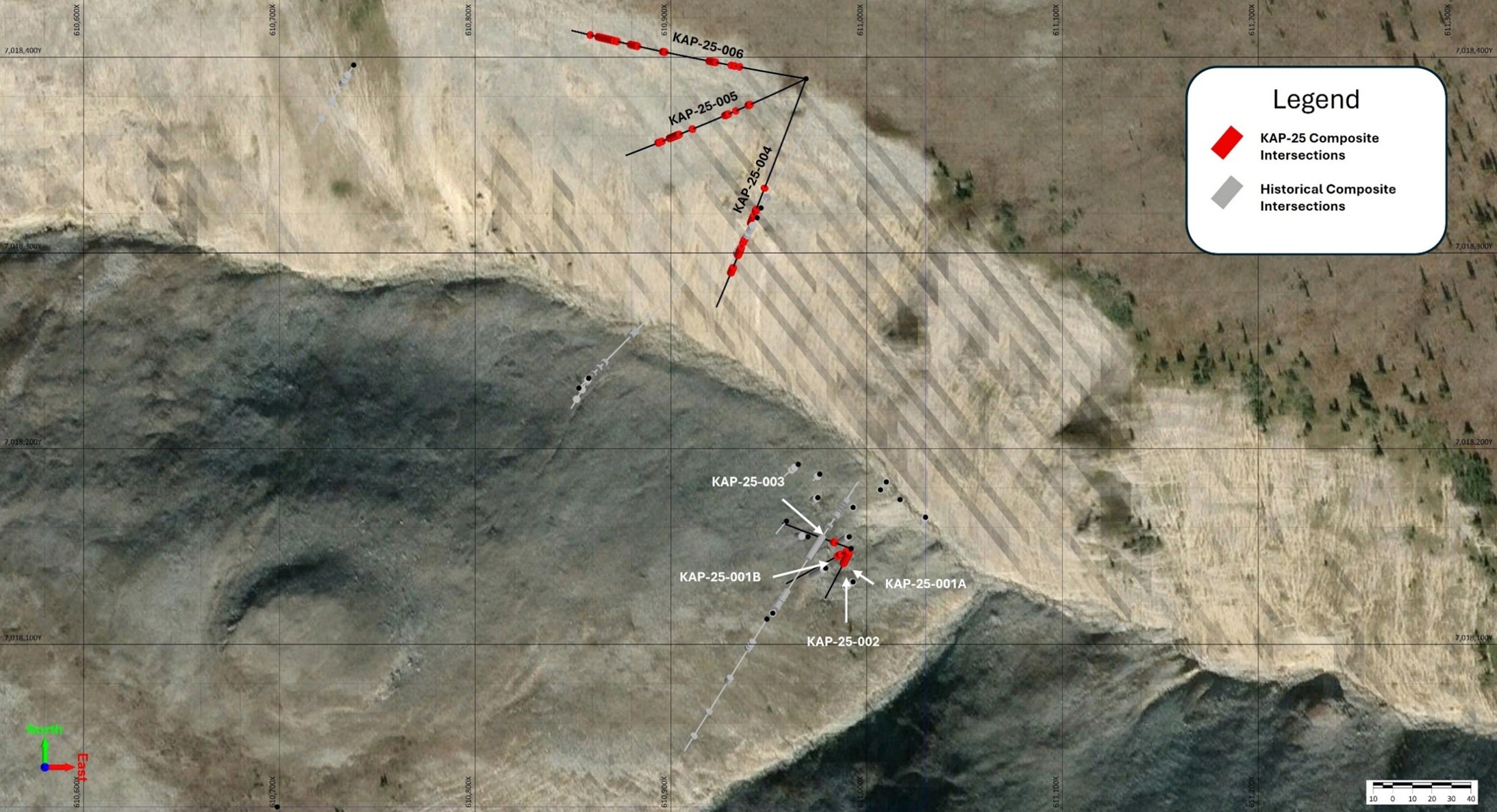
Figure 2: Composite intervals in 2025 drilling.
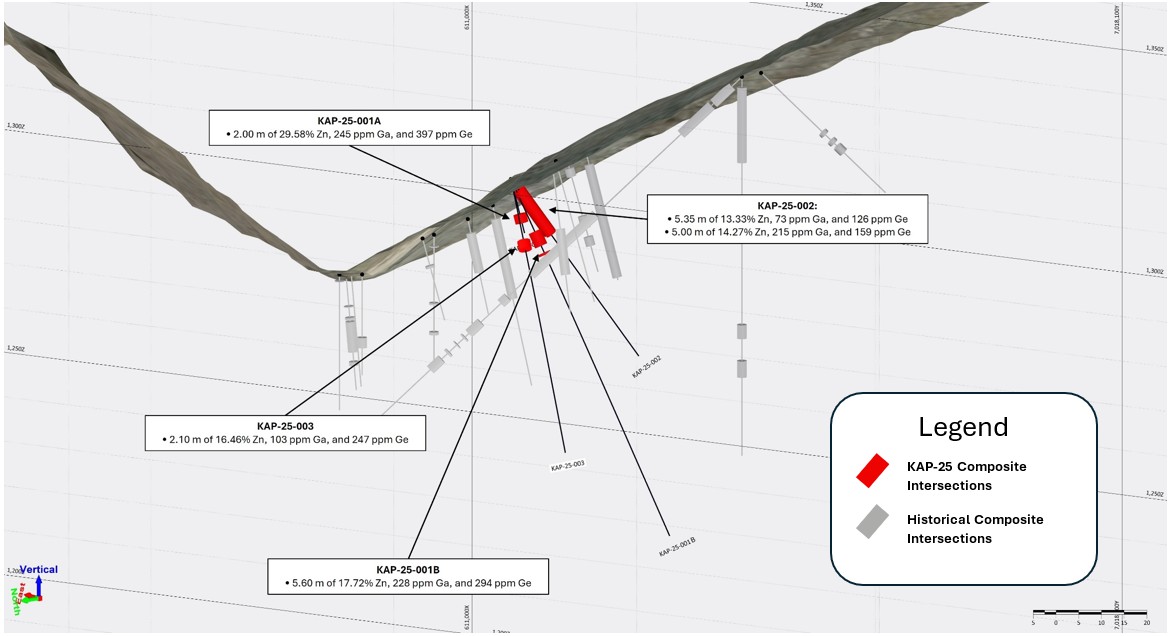
Figure 3: Oblique section showing KAP-25-001A, KAP-25-001B, KAP-25-002, and KAP-25-003.
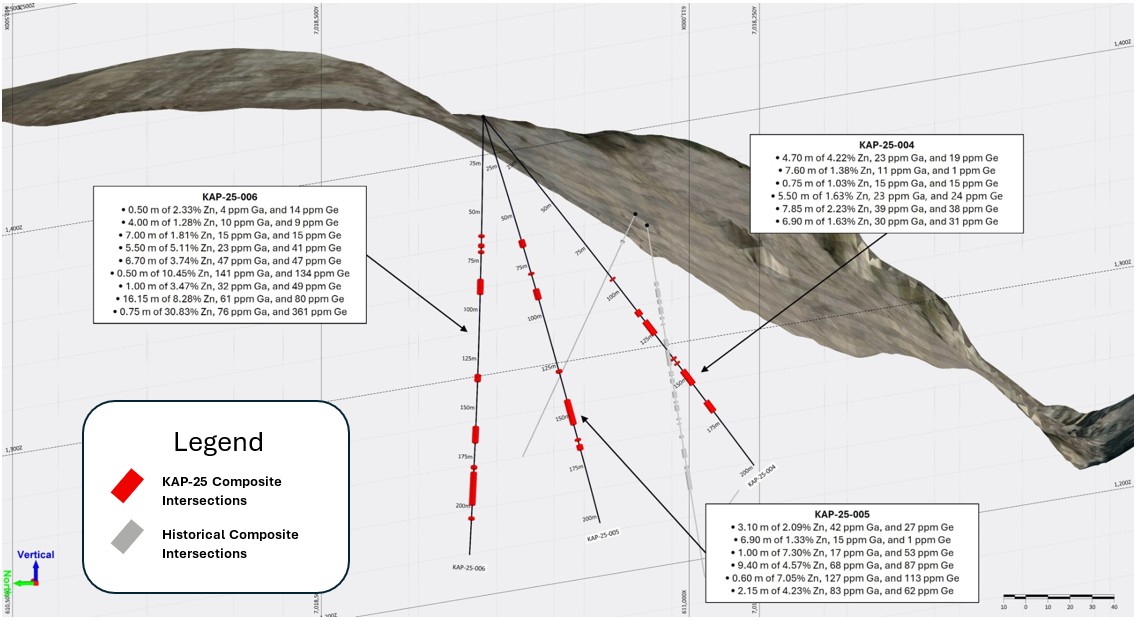
Figure 4: Oblique section showing KAP-25-004, KAP-25-005, and KAP-25-006.
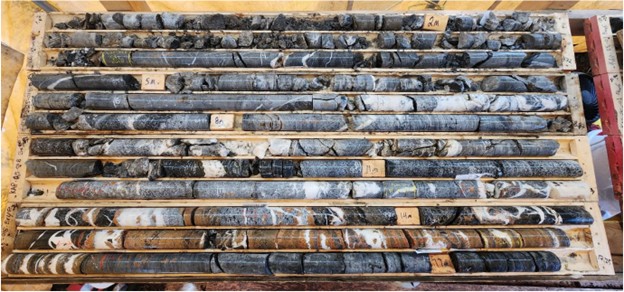
Figure 5: Core from KAP-25-001B between 1.40 m and 17.25 m showing intervals of Manetoe Facies with locally strong zinc-gallium-germanium mineralization. Mineralized sections occur as discrete zones within a broader sequence of variably altered and veined carbonate host rocks.
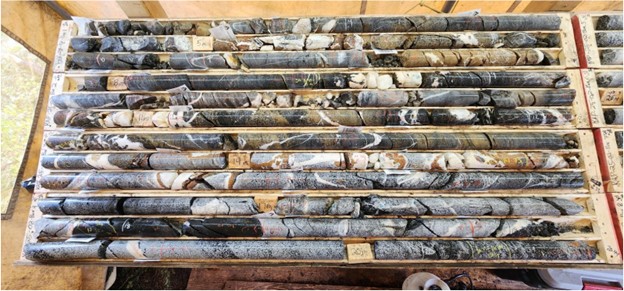
Figure 6: Core from KAP-25-002 between 3.15 m and 20.44 m illustrating a broad interval of Manetoe-related lithologies containing several zones of elevated zinc-gallium-germanium mineralization. Mineralized horizons are interspersed with unmineralized to weakly mineralized carbonates, breccias, and alteration domains.
Table 1: Drill results from the 2025 campaign.
| Hole | Type | From (m) | To (m) | Interval (m) | Zn (%) | Ga (ppm) | Ge (ppm) |
| KAP-25-001A | Primary | 8.00 | 10.00 | 2.00 | 29.58 | 245 | 397 |
| KAP-25-001B | Primary | 12.70 | 18.30 | 5.60 | 17.72 | 228 | 294 |
| Including | 12.70 | 16.15 | 3.45 | 28.26 | 362 | 473 | |
| Including | 17.80 | 18.30 | 0.50 | 3.10 | 45 | 21 | |
| KAP-25-002 | Primary | 3.15 | 8.50 | 5.35 | 13.33 | 73 | 126 |
| Including | 3.15 | 4.40 | 1.25 | 13.28 | 46 | 110 | |
| Including | 5.00 | 6.00 | 1.00 | 30.70 | 100 | 330 | |
| Including | 7.50 | 8.00 | 0.50 | 43.28 | 411 | 371 | |
| KAP-25-002 | Primary | 10.50 | 15.50 | 5.00 | 14.27 | 215 | 159 |
| Including | 11.00 | 11.60 | 0.60 | 28.30 | 169 | 198 | |
| Including | 12.10 | 12.90 | 0.80 | 16.00 | 278 | 98 | |
| Including | 13.80 | 15.00 | 1.20 | 21.10 | 382 | 363 | |
| KAP-25-003 | Primary | 15.00 | 17.10 | 2.10 | 16.46 | 103 | 247 |
| KAP-25-004 | Primary | 93.65 | 114.85 | 4.70 | 4.22 | 23 | 19 |
| Including | 93.65 | 94.50 | 0.85 | 2.65 | 5 | 9 | |
| Including | 112.00 | 114.85 | 2.85 | 6.13 | 36 | 28 | |
| KAP-25-004 | Primary | 118.00 | 125.60 | 7.60 | 1.38 | 11 | 1 |
| Including | 118.00 | 118.50 | 0.50 | 2.89 | 30 | 44 | |
| Including | 119.50 | 120.00 | 0.50 | 2.79 | 33 | 54 | |
| Including | 121.50 | 122.00 | 0.50 | 2.43 | 31 | 28 | |
| Including | 123.00 | 123.60 | 0.60 | 2.12 | 29 | 26 | |
| Including | 124.50 | 125.10 | 0.60 | 2.13 | 18 | 9 | |
| KAP-25-004 | Primary | 128.75 | 129.50 | 0.75 | 1.03 | 15 | 15 |
| KAP-25-004 | Primary | 137.00 | 142.50 | 5.50 | 1.63 | 23 | 24 |
| Including | 139.00 | 139.50 | 0.50 | 3.27 | 45 | 65 | |
| Including | 141.65 | 142.50 | 0.85 | 6.44 | 78 | 77 | |
| KAP-25-004 | Primary | 146.15 | 154.00 | 7.85 | 2.23 | 39 | 38 |
| Including | 146.15 | 147.15 | 1.00 | 4.00 | 62 | 73 | |
| Including | 147.65 | 148.15 | 0.50 | 2.18 | 54 | 41 | |
| Including | 148.65 | 149.20 | 0.55 | 6.49 | 122 | 97 | |
| Including | 150.10 | 150.60 | 0.50 | 7.79 | 140 | 121 | |
| Including | 151.80 | 152.30 | 0.50 | 4.09 | 55 | 72 | |
| Including | 153.50 | 154.00 | 0.50 | 5.55 | 94 | 93 | |
| KAP-25-004 | Primary | 162.70 | 169.60 | 6.90 | 1.63 | 30 | 31 |
| Including | 163.70 | 164.30 | 0.60 | 4.51 | 91 | 82 | |
| Including | 165.30 | 165.80 | 0.50 | 3.84 | 63 | 70 | |
| Including | 167.40 | 167.90 | 0.50 | 3.18 | 66 | 55 | |
| Including | 168.80 | 169.60 | 0.80 | 3.90 | 59 | 76 | |
| KAP-25-005 | Primary | 62.20 | 65.30 | 3.10 | 2.09 | 42 | 27 |
| Including | 62.20 | 63.70 | 1.50 | 3.00 | 74 | 43 | |
| Including | 64.75 | 65.30 | 0.55 | 2.52 | 25 | 15 | |
| KAP-25-005 | Primary | 78.60 | 91.50 | 6.90 | 1.33 | 15 | 1 |
| Including | 78.60 | 79.10 | 0.50 | 2.25 | 105 | 39 | |
| Including | 86.75 | 87.25 | 0.50 | 2.50 | 4 | 15 | |
| Including | 88.25 | 89.00 | 0.75 | 2.07 | 32 | 21 | |
| Including | 90.00 | 91.50 | 1.50 | 2.74 | 30 | 38 | |
| KAP-25-005 | Primary | 127.10 | 128.10 | 1.00 | 7.30 | 17 | 53 |
| Including | 127.10 | 127.60 | 0.50 | 13.35 | 19 | 89 | |
| KAP-25-005 | Primary | 142.00 | 151.40 | 9.40 | 4.57 | 68 | 87 |
| Including | 142.00 | 142.50 | 0.50 | 5.06 | 71 | 93 | |
| Including | 144.40 | 145.60 | 1.20 | 4.51 | 74 | 75 | |
| Including | 146.10 | 148.55 | 2.45 | 9.98 | 138 | 202 | |
| Including | 149.20 | 149.70 | 0.50 | 6.41 | 100 | 92 | |
| Including | 150.40 | 151.40 | 1.00 | 6.74 | 104 | 127 | |
| KAP-25-005 | Primary | 161.40 | 162.00 | 0.60 | 7.05 | 127 | 113 |
| KAP-25-005 | Primary | 164.35 | 166.50 | 2.15 | 4.23 | 83 | 62 |
| Including | 164.35 | 165.40 | 1.05 | 4.40 | 69 | 67 | |
| Including | 165.90 | 166.50 | 0.60 | 7.11 | 165 | 102 | |
| KAP-25-006 | Primary | 61.30 | 61.80 | 0.50 | 2.33 | 4 | 14 |
| KAP-25-006 | Primary | 66.00 | 70.00 | 4.00 | 1.28 | 10 | 9 |
| Including | 66.00 | 67.00 | 1.00 | 2.39 | 14 | 6 | |
| Including | 69.50 | 70.00 | 0.50 | 2.78 | 20 | 10 | |
| KAP-25-006 | Primary | 84.00 | 91.00 | 7.00 | 1.81 | 15 | 15 |
| Including | 85.00 | 87.00 | 2.00 | 2.99 | 28 | 31 | |
| KAP-25-006 | Primary | 132.00 | 137.50 | 5.50 | 5.11 | 23 | 41 |
| Including | 132.55 | 133.05 | 0.50 | 21.80 | 63 | 175 | |
| Including | 133.55 | 134.05 | 0.50 | 3.57 | 61 | 52 | |
| Including | 135.00 | 135.50 | 0.50 | 26.00 | 52 | 169 | |
| KAP-25-006 | Primary | 157.50 | 164.20 | 6.70 | 3.74 | 47 | 47 |
| Including | 159.00 | 160.00 | 1.00 | 6.51 | 85 | 79 | |
| Including | 161.00 | 161.50 | 0.50 | 7.32 | 81 | 99 | |
| Including | 162.60 | 163.10 | 0.50 | 5.45 | 81 | 79 | |
| Including | 163.60 | 164.20 | 0.60 | 19.10 | 211 | 215 | |
| KAP-25-006 | Primary | 166.20 | 166.70 | 0.50 | 10.45 | 141 | 134 |
| KAP-25-006 | Primary | 179.00 | 180.00 | 1.00 | 3.47 | 32 | 49 |
| KAP-25-006 | Primary | 182.20 | 198.35 | 16.15 | 8.28 | 61 | 80 |
| Including | 182.20 | 182.80 | 0.60 | 4.10 | 46 | 56 | |
| Including | 184.00 | 185.50 | 1.50 | 14.05 | 73 | 115 | |
| Including | 187.00 | 189.50 | 2.50 | 22.69 | 172 | 217 | |
| Including | 190.50 | 193.00 | 2.50 | 5.39 | 70 | 66 | |
| Including | 193.50 | 194.50 | 1.00 | 7.50 | 86 | 90 | |
| Including | 195.00 | 196.65 | 1.65 | 15.62 | 63 | 130 | |
| Including | 197.15 | 198.35 | 1.20 | 3.99 | 36 | 50 | |
| KAP-25-006 | Primary | 205.10 | 205.85 | 0.75 | 30.83 | 76 | 361 |
* Mineralized intervals were composited using a minimum sample threshold of 1.0% Zn, 30 ppm Ga, or 30 ppm Ge, with intervals required to both start and end above cut-off. Up to 2.0 metres of consecutive internal dilution were permitted within a composite, provided the overall interval maintained geological and grade continuity. “Including” intervals were reported where grades exceeded twice the value of any primary cut-off over a continuous run. All averages were length-weighted using original assay sample lengths. Reported thicknesses represent apparent widths, as true widths remain undetermined at this stage of drilling.
Table 2: 2025 drilling summary.
| Hole | Length (m) | Target | Easting (m) | Northing (m) | Elevation (m, ASL) | Azimuth (°) | Dip (°) |
| KAP-25-001A | 12.35 | Central Zone | 610992 | 7018149 | 1303 | 240.00 | -75.00 |
| KAP-25-001B | 86.00 | Central Zone | 610992 | 7018149 | 1303 | 240.80 | -63.70 |
| KAP-25-002 | 50.00 | Central Zone | 610992 | 7018149 | 1303 | 207.28 | -55.18 |
| KAP-25-003 | 66.00 | Central Zone | 610992 | 7018149 | 1303 | 289.95 | -55.35 |
| KAP-25-004 | 200.00 | North Zone | 610969 | 7018389 | 1406 | 200.09 | -49.97 |
| KAP-25-005 | 203.00 | North Zone | 610969 | 7018389 | 1406 | 244.29 | -59.45 |
| KAP-25-006 | 224.00 | North Zone | 610969 | 7018389 | 1406 | 279.37 | -55.47 |
* Coordinates listed in NAD83 UTM Zone 9N.
On Behalf of the Board Directors
Paul Sparkes
Chief Executive Officer
825-414-3163
ABOUT INTEGRAL METALS CORP.
Integral is an exploration stage company, engaged in the business of mineral exploration for critical minerals, including gallium, germanium, and rare earth elements, with the goal of contributing to the development of a domestic supply chain for these minerals. Integral holds properties in mining-friendly jurisdictions in Canada and the United States of America, including the Northwest Territories, Manitoba and Montana, where it has received regulatory support for its exploration efforts.
Forward-Looking Information
Certain statements contained in this press release constitute forward-looking information. These statements relate to future events or future performance. The use of any of the words “could”, “intend”, “expect”, “believe”, “will”, “projected”, “estimated” and similar expressions and statements relating to matters that are not historical facts are intended to identify forward-looking information and are based on the Company’s current beliefs or assumptions as to the outcome and timing of such future events. In particular, this press release contains forward-looking information relating to, among other things, the Company’s future plans, including the Company’s plans to focus its efforts and resources on the Kap Property and its other mineral properties.
Various assumptions or factors are typically applied in drawing conclusions or making the forecasts or projections set out in forward-looking information, including, in respect of the forward-looking information included in this press release, assumptions regarding the future plans and strategies of the Company, including that the Company will continue to focus its efforts and resources on the Kap Property.
Although forward-looking information is based on the reasonable assumptions of the Company’s management, there can be no assurance that any forward-looking information will prove to be accurate. Forward-looking information involves known and unknown risks, uncertainties and other factors which may cause the actual results, performance or achievements to be materially different from any future results, performance or achievements expressed or implied by the forward-looking information. Such factors include, among other things, the risk that the Company’s business prospects and priorities may change, whether as a result of unexpected events, general market and economic conditions or as a result of the Company’s future exploration efforts, and that any such change may result in a re-deployment of the Company’s resources and efforts in a manner divergent from the Company’s current business plan or strategy. The forward-looking information contained in this release is made as of the date hereof, and the Company is not obligated to update or revise any forward-looking information, whether as a result of new information, future events or otherwise, except as required by applicable securities laws. Because of the risks, uncertainties and assumptions contained herein, investors should not place undue reliance on forward-looking information. The foregoing statements expressly qualify any forward-looking information contained herein.
Figures accompanying this announcement are available at
https://www.globenewswire.com/NewsRoom/AttachmentNg/b8660995-c187-4a03-868d-135d51bfd641
https://www.globenewswire.com/NewsRoom/AttachmentNg/98cf2e9c-5b86-4e50-9cc0-ee2e70c42e78
https://www.globenewswire.com/NewsRoom/AttachmentNg/98458aef-a122-4cdb-b6b6-620fa692d1eb
https://www.globenewswire.com/NewsRoom/AttachmentNg/bc2cdf8c-88ea-4f13-9dfb-361bcd15a162
https://www.globenewswire.com/NewsRoom/AttachmentNg/f97f76cc-bc1e-41d7-99cd-f3eccde3b2f9
https://www.globenewswire.com/NewsRoom/AttachmentNg/d4d48991-c102-4c76-a3dd-10e88a64cb08