Mayfair, London, March 09, 2026 (GLOBE NEWSWIRE) -- The rare earth metals market is becoming strategic as global industries transition toward electrification, renewable energy systems and advanced electronics manufacturing. Rare earth metals market is estimated to be valued at USD 19.3 billion in 2026 and is forecast to reach USD 33.7 billion by 2033, expanding at a CAGR of 8.3% over 2026 and 2033. Escalating export controls are forcing a massive strategic shift toward localized extraction and advanced recycling across the critical minerals ecosystem. With the global rare earth metals market pivoting rapidly away from monopolized supply chains, Western government interventions including multi-billion-dollar equity stakes are transforming the industry.
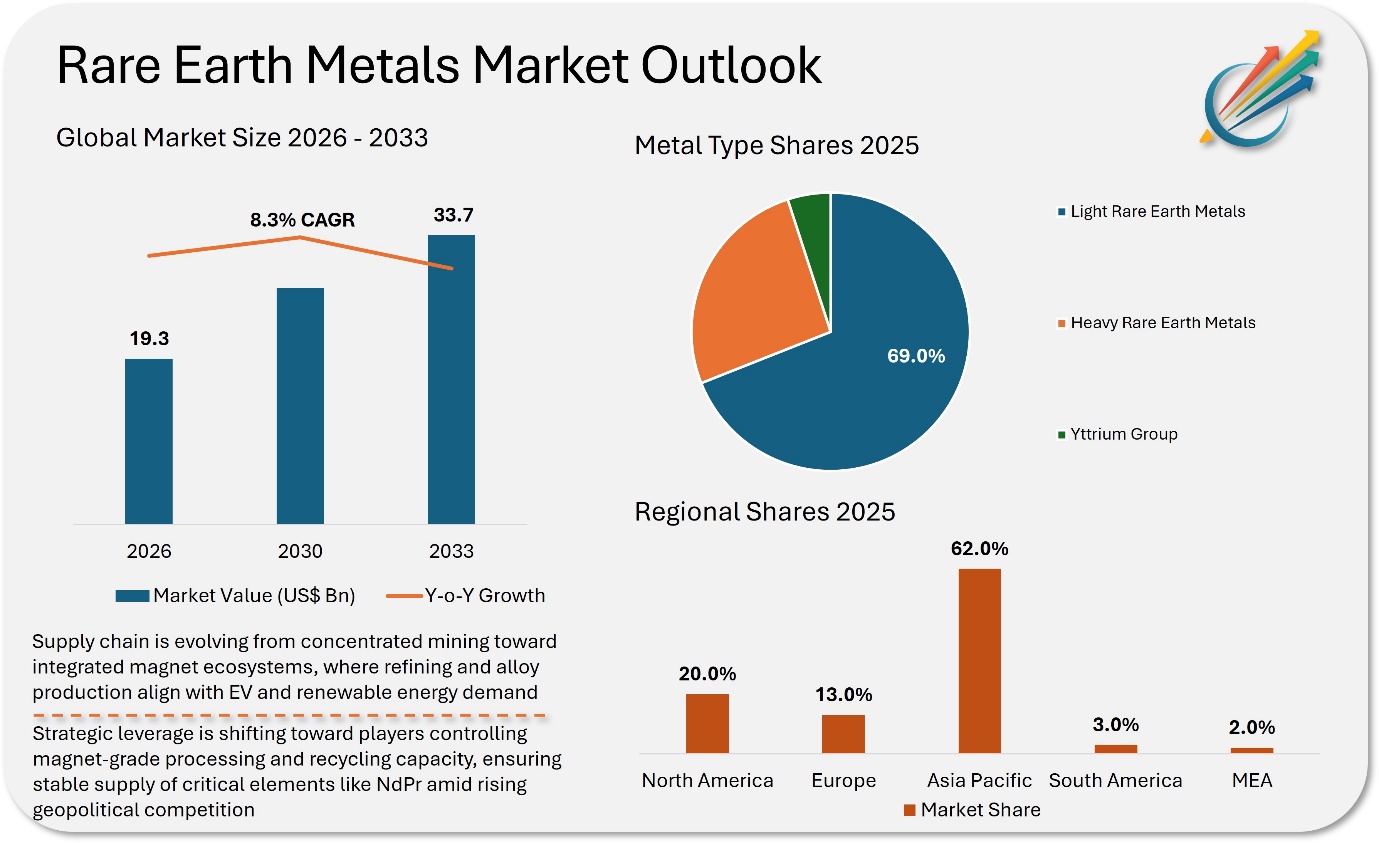
The market is undergoing structural transformation as governments and manufacturers seek to diversify supply chains beyond traditional mining hubs. Rising investments in rare earth processing facilities, recycling technologies, strategic reserves, etc. are reshaping the global value chain. Demand from electric vehicles, wind turbines, consumer electronics, and defense systems continues to strengthen the rare earth metals market positioning as essential materials within the global energy transition and next-generation technology ecosystem.
Access the Executive Summary & Sample Data: https://marketmindsadvisory.com/request-sample/?report_id=17150
Key Takeaways from Rare Earth Metals Market
- Neodymium remains a prominent type due to its irreplaceable role in NdFeB permanent magnets.
- Secondary sourcing and recycling are projected to be fast-growing source segments during the forecast period.
- North America is emerging as a key investment hotspot, driven by state-sponsored infrastructure funding and defense mandates.
- Competition is increasing due to aggressive M&A as Western firms build closed-loop mine-to-magnet capabilities.
- Rising demand for heavy rare earths, such as, dysprosium and terbium, is creating new value pools for alternative processors.
- Recycling of rare earth elements from electronic waste and end-of-life magnets gaining momentum as a secondary supply source.
Market Dynamics Shaping the Rare Earth Metals Market
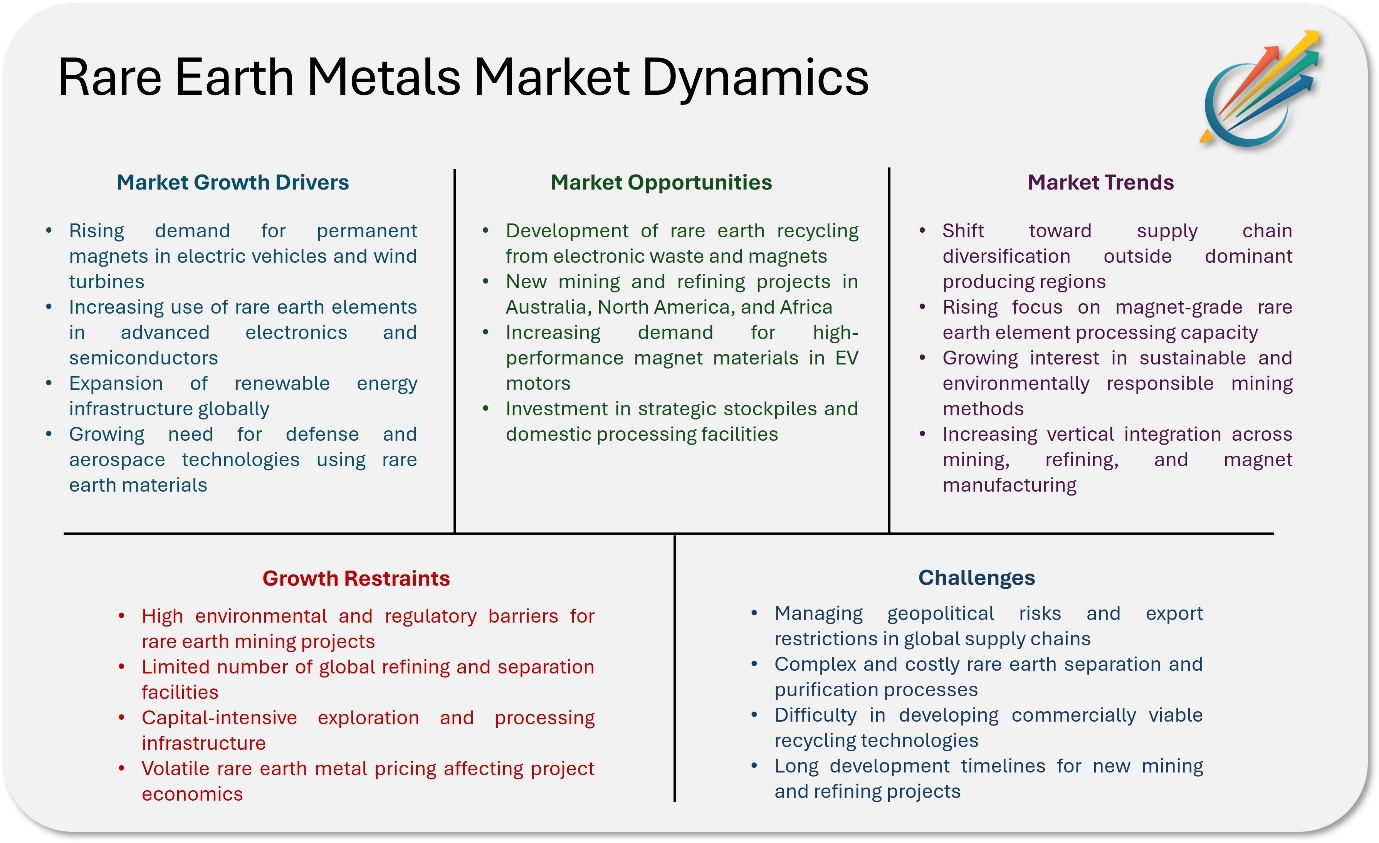
Expansion of EVs and Renewable Energy Bolstering Rare Earth Metals Market
Adoption of electric vehicles and renewable energy systems is driving the rare earth metals market. High-performance permanent magnets used in EV motors and wind turbine generators rely heavily on rare earth elements such as, neodymium and dysprosium. As governments all over the globe are pushing for carbon neutrality and electrification of transportation, demand for these materials continues to rise. Automotive manufacturers are expanding production of EVs, while wind energy installations are growing rapidly which is significantly increasing consumption of rare earth metals across multiple industrial sectors.
Supply Chain Diversification and Strategic Resource Development creating ample Opportunities in Rare Earth Metals Market
Growing geopolitical concerns surrounding rare earth supply concentration are creating opportunities for new mining projects and processing facilities. Governments in the United States, Europe, Australia and Japan are investing in domestic rare earth supply chains to reduce dependence on a limited number of global producers. Further the Pax Silica has accelerated exploration activities, rare earth refining investments, and strategic stockpiling initiatives. Furthermore, advancements in recycling technologies and rare earth recovery from electronic waste are opening alternative supply channels for rare earth metals market players.
Request Region-Segment-Specific Data Analysis: https://marketmindsadvisory.com/request-customization/?report_id=17150
Environmental Concerns and Complex Processing Requirements affecting Rare Earth Metals Market Growth
Rare earth metal extraction and processing involve complex procedures and significant environmental considerations. Mining activities generate radioactive waste and chemical byproducts that require environmental management. As regulatory scrutiny intensifies, companies should invest in sustainable extraction techniques and advanced waste treatment systems. These environmental and regulatory challenges increase operational costs and extend project development timelines impacting investments magnitude in rare earth metals market. Moreover, rare earth refining requires specialized processing infrastructure and technical expertise, creating barriers to entry for new players limiting rapid expansion of supply capacity.
Rare Earth Metals Market Segmentation
By Metal Type
- Light Rare Earth Metals
- Lanthanum
- Cerium
- Praseodymium
- Neodymium
- Samarium
- Heavy Rare Earth Metals
- Gadolinium
- Terbium
- Lutetium
- Holmium
- Erbium
- Thulium
- Ytterbium
- Dysprosium
- Yttrium Group
Neodymium and praseodymium are prominent in rare earth metals market owing to their role in manufacturing high-performance permanent magnets used in EV motors and wind turbine generators. These metals represent a significant portion of global demand due to their superior magnetic properties. Dysprosium and terbium are also gaining importance as they enhance magnet performance at high temperatures, which is essential for advanced electric powertrains. Lanthanum and cerium continue to be widely used in catalysts, glass polishing and battery technologies.
By Source Type
- Bastnäsite Ore
- Monazite Ore
- Xenotime Ore
- Ion-Adsorption Clays
- Recycling Streams
Primary mining remains the prominent source of rare earth metals, with large-scale extraction activities concentrated in regions with significant mineral deposits. However, recycling is emerging as a important secondary source in rare earth metals market as industries seek sustainable and secure supply alternatives. Recycling processes recover elements from discarded electronics, batteries, and end-of-life permanent magnets. Although recycling currently represents a smaller share of global supply, technological advancements in recovery processes are improving economic feasibility. Recycling is expected to grow in the coming years as governments promote circular economy initiatives and resource efficiency.
By Form
- Oxides (REO)
- Metals And Alloys
- Compounds And Salts
- Powders And Granules
Rare earth oxides account for the largest share in rare earth metals market because they represent primary intermediate product in the value chain. These oxides are further refined and converted into metals and alloys for various industrial applications. Rare earth metals are used in high-tech manufacturing processes where precise material properties are required. Alloys, especially those used in permanent magnet production, are witnessing strong demand growth as electrification technologies expand.
By Processing Type
- Hydrometallurgical Processing
- Pyrometallurgical Processing
- Solvent Extraction Based Separation
- Ion Exchange Based Separation
Hydrometallurgical processing leads in rare earth metals market by delivering higher selectivity and reduced energy consumption compared with alternative methods, making it the preferred approach for most facilities, particularly those managing complex ore bodies containing multiple rare earth elements. Pyrometallurgical processing continues to hold importance in integrated operations where high-temperature treatment performs dual roles, including primary ore concentration and downstream alloy production. Solvent extraction separation is increasingly becoming the core technology for isolating individual rare earth elements from mixed concentrates, and this is where significant technical differentiation is emerging.
By End Use
- Automotive
- Permanent Magnets
- Emissions Control Catalysts
- Sensors & Actuators
- Electronics & Consumer Devices
- Renewable Energy
- Defense & Aerospace
- Guidance Systems & Sensors
- High-Performance Alloys & Magnets
- Industrial & Manufacturing
- Petrochemical Processes Catalysts
- Glass & Semiconductors
- Chemical & Metallurgical Industry
- Healthcare & Medical
- Lighting & Displays
- Glass, Ceramics & Pigments
- Battery & Energy Storage
Automotive sector is one of the prominent consumers of rare earth as electric vehicles require powerful permanent magnets for traction motors. Renewable energy is another major end-use segment, with wind turbine generators heavily dependent on rare earth magnet technology. Electronics manufacturers also utilize rare earth elements in smartphones, displays and advanced electronic components. Defense and aerospace industries rely on rare earth metals for precision-guided systems, radar equipment, advanced materials and others. Industrial applications, including catalysts and polishing compounds continue to represent stable demand in rare earth metals market.
By Region
- North America
- Europe
- Asia Pacific
- South America
- MEA
Asia-Pacific is the prominent region in the rare earth metals market, led by China, which accounts for a large portion of global mining and processing capacity. The region also benefits from strong demand from electronics manufacturing and electric vehicle production. Australia is emerging as an important mining hub as new rare earth extraction projects expand supply outside traditional markets. Meanwhile, North America increasing investments in domestic refining and supply chain resilience initiatives. Countries like the U.S. and Canada are heavily investing in localized mine-to-magnet supply chains. With strong policy support and strategic investments, Asia-Pacific is expected to maintain leadership while global supply diversification efforts accelerate.
Secure Full Access to Decision-Grade Data: https://marketmindsadvisory.com/buy-now/?report_id=17150
Competitive Landscape – Rare Earth Metals Market
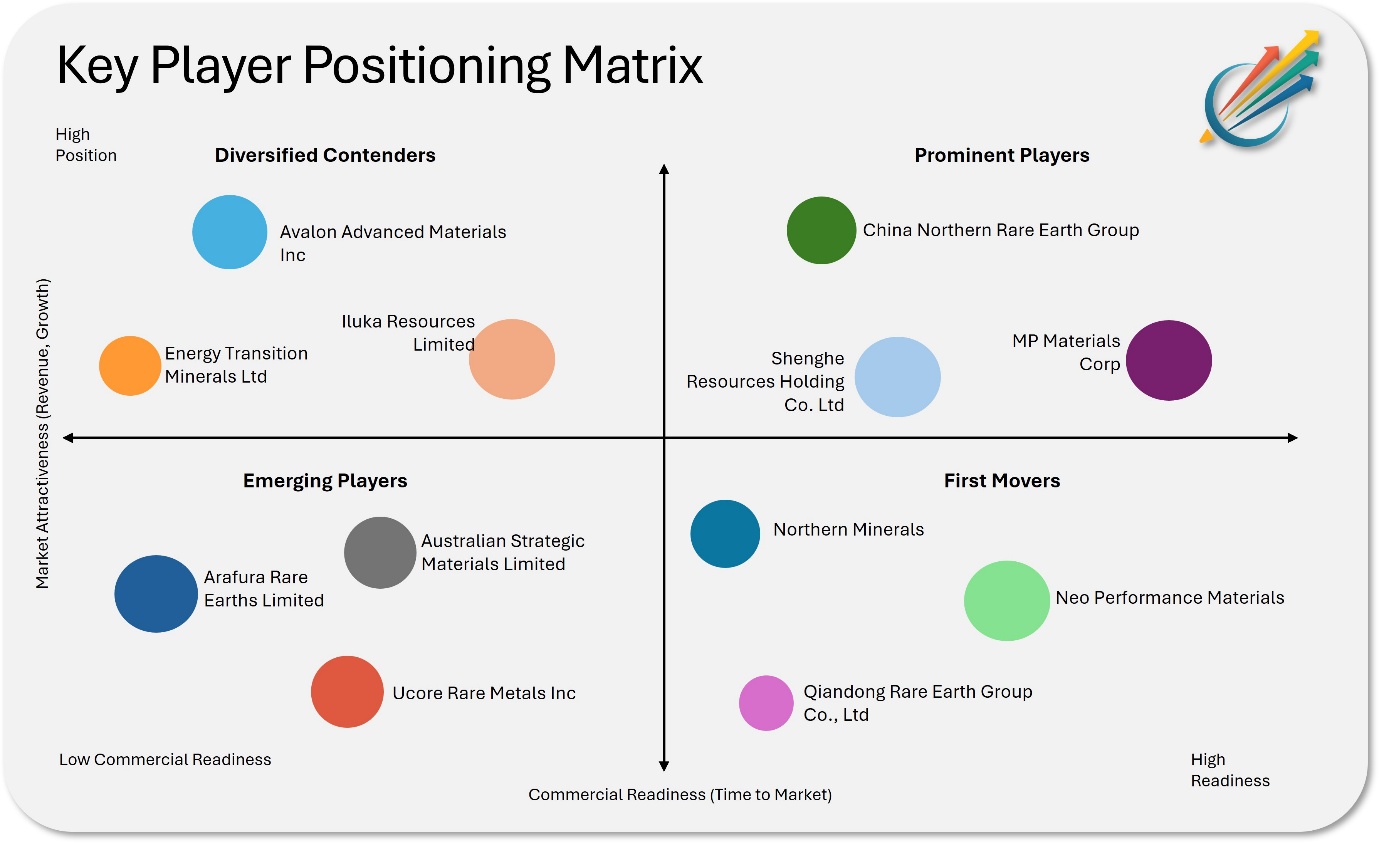
The rare earth metals market is characterized by a combination of large mining companies, specialized processing firms and vertically integrated magnet manufacturers. Key players are focusing on strategic mining partnerships, long-term supply agreements with EV and renewable energy manufacturers, and investments in refining and magnet production facilities. Vertical integration across mining, processing, and magnet manufacturing is becoming a key competitive strategy, enabling companies to secure supply chains and capture value within the expanding rare earth ecosystem.
Key Players in Rare Earth Metals Market are
- China Northern Rare Earth Group
- China Rare Earth Resources and Technology
- Qiandong Rare Earth Group
- Shenghe Resources Holding
- China Rare Earth Holdings Limited
- Lynas Rare Earths
- MP Materials
- Iluka Resources Limited
- Arafura Rare Earths
- Neo Performance Materials
- Australian Strategic Materials
- Ucore Rare Metals
- Energy Fuels Inc
- Alkane Resources Limited
- Energy Transition Minerals
- Texas Mineral Resources
- Avalon Advanced Materials
- Rainbow Rare Earths Ltd
- Rare Element Resources Ltd
- Northern Minerals
Key Developments:
- In February 2025, Lynas Rare Earths commissioned its Kalgoorlie rare earth processing facility in Australia, establishing a major cracking and leaching plant expanding rare earth processing capacity outside China.
- In April 2025, China introduced strict export controls on rare earth technologies, effectively restricting the export of machinery and intellectual property required for producing high-performance permanent magnets.
- In July 2025, MP Materials partnered with the U.S. Department of Defense to advance the development of a fully integrated domestic rare earth magnet supply chain.
- In December 2025, U.S. led international initiative launched Pax Silica to secure and diversify supply chains for AI, semiconductors, and critical minerals among trusted partners.
Explore the Full Industry Intelligence Suite: https://marketmindsadvisory.com/rare-earth-metals-market-trends/
Trending Related Reports
The dysprosium market is projected to grow significantly, with its valuation increasing from USD 6.3 billion in 2025 to USD 10.8 billion by 2035, at a compound annual growth rate (CAGR) of 6.2%.
The cerium oxide nanoparticle market is anticipated to grow significantly, reaching a valuation of USD 806.4 million in 2024 and USD 6 billion by 2034, expanding at a robust CAGR of 21.0% during the forecast period.
The bonded magnets market is projected to grow at a steady CAGR of 5.8% during the forecast period from 2024 to 2034.
The mining equipment market is estimated at around USD 134.5 billion in 2025, with steady expansion expected through the next investment cycle owing to rise in demand for critical mineral extraction.
The europium market is projected to reach USD 247.6 million in 2025, growing at a CAGR of 6.4% to surpass USD 419.5 million by 2035
The mining explosives consumables market, valued at approximately USD 132.2 million in 2025, is poised to grow significantly, reaching USD 225.8 million by 2035.
The magnetic materials market is projected to reach USD 20.845 billion in 2025, growing significantly to approximately USD 41.286 billion by 2035, with an anticipated CAGR of 8.3% over the forecast period.
The battery materials market is projected to reach a valuation of USD 58.9 billion in 2024, expanding at a CAGR of 6.9% over the forecast period.
The advanced automotive materials market is anticipated to experience robust growth, projected to expand at a CAGR of 7.8% during the forecast period from 2025 to 2035.
The Mining Flotation Chemicals market is expected to grow significantly, with its valuation projected to increase from USD 12,885.5 million in 2025 to USD 20,360.2 million by 2035, expanding at a CAGR of 6% during the forecast period.
Why choose Market Minds Advisory
Market Minds Advisory delivers decision-grade intelligence trusted by executives across machinery & equipment, packaging, chemical, automotive, information & communication technology, food & beverage, consumer goods, healthcare and other industries. We provide market expansion strategies, go-to-market strategies, market share acceleration, brand positioning analysis, and account enablement and growth. Our forecasting methodology integrates primary interviews, proprietary demand models and continuous market validation to ensure accuracy in volatile and emerging industries. With over 10 years of industry experience and insights derived from primary interviews with several industry stakeholders, our research provides actionable insights and white space analysis for the emerging segments providing the opportunity gaps in the market accounting recent market developments and geopolitical risks. We believe in unlocking growth by helping businesses to see the future of their markets.
Contact Us

Market Minds Advisory

86 Great Portland Street, Mayfair, London,

W1W 7FG, England, United Kingdom

T: +44 020 3807 7725
Email: sales@marketmindsadvisory.com
Website: https://marketmindsadvisory.com/
LinkedIn | Facebook | Twitter | Instagram
Attachments

Contact Us Market Minds Advisory 86 Great Portland Street, Mayfair, London, W1W 7FG, England, United Kingdom T: +44 020 3807 7725