Skimping on bills, pills and frills: Achieve survey finds over half of Americans face tough tradeoffs to manage household debt
PR Newswire
SAN MATEO, Calif., Feb. 9, 2026
From slashing essential spending and delaying healthcare to burning through savings and borrowing from friends, the majority of Americans say they must choose between their financial obligations and daily necessities.
SAN MATEO, Calif., Feb. 9, 2026 /PRNewswire/ -- Overwhelmed by debt and a cost-of-living crisis, the math isn't mathing for most American households. During the last three months of 2025, over half of consumers (51%) resorted to one or more risky financial stopgaps after they fell short on what they already owed, according to a new survey by Achieve, the leader in digital personal finance.
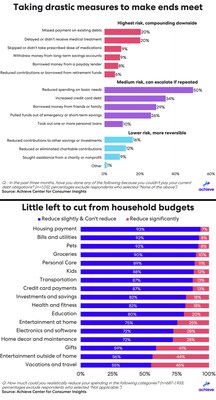
Achieve's survey reveals a sharp split in how households are absorbing the squeeze. Among consumers who took at least one action, many said they reduced spending on basic needs (50%), increased credit card debt (34%) and pulled funds from emergency or short-term savings (26%). In more severe situations, 20% missed at least one debt payment and 20% delayed or didn't receive medical treatment. Another 9% skipped or reduced prescribed medication doses.
"This is what the K-shaped economy looks like in the real world. There's an affluent half of the population whose financial lives aren't disrupted by momentary inconveniences. But for everyone else, financial triage and tradeoffs are a way of life," said Achieve Co-Founder and Co-CEO Andrew Housser. "Not only are these consumers risking their financial wellness, but many are endangering their physical and mental health, too. The longer this persists, the more the gap widens, because actions like missed payments and delayed healthcare are hard to unwind once they start."
Taking drastic measures to make ends meet | ||
Financial Stopgap | Percent of Consumers | Risk Level |
Missed payment on existing debts | 20 % | Highest |
Delayed or didn't receive medical treatment | 20 % | Highest |
Skipped or didn't take prescribed dose of medications | 9 % | Highest |
Withdrew money from long-term savings accounts | 9 % | Highest |
Borrowed money from a payday lender | 8 % | Highest |
Reduced contributions or borrowed from retirement funds | 6 % | Highest |
Reduced spending on basic needs | 50 % | Medium |
Increased credit card debt | 34 % | Medium |
Borrowed money from friends or family | 29 % | Medium |
Pulled funds out of emergency or short-term savings | 26 % | Medium |
Took out one or more personal loans | 10 % | Medium |
Reduced contributions to other savings or investments | 16 % | Lower |
Reduced or eliminated charitable contributions | 12 % | Lower |
Sought assistance from a charity or nonprofit | 9 % | Lower |
Other | 1 % | Lower |
Q: In the past three months, have you done any of the following because you couldn't pay your current debt obligations? (n=1,012; percentages exclude respondents who selected "None of the above") Source: Achieve Center for Consumer Insights | ||
Budget Belt-Tightening Down to the Last Notch
Consumers' dependence on dicey financial coping strategies comes as many say they are close to the limit of what they can cut from household spending. Respondents said they can only reduce spending slightly or not at all in essential categories including housing costs (93%), bills and utilities (92%), groceries (90%), and transportation (87%). Most households are also out of easy cuts in discretionary spending categories, including entertainment at home (75%), gift-giving (59%), entertainment outside home (56%) and vacations (55%).
"Many consumers' belt-tightening efforts have reached the last notch," Housser said. "That makes staying current on debts much harder when prices or payments increase and leaves households more exposed to even routine surprises."
Little left to cut from household budgets | ||
Spending Categories | Reduce slightly & Can't reduce | Reduce significantly |
Housing payment | 93 % | 7 % |
Bills and utilities | 92 % | 8 % |
Pets | 92 % | 8 % |
Groceries | 90 % | 10 % |
Personal Care | 89 % | 11 % |
Kids | 88 % | 12 % |
Transportation | 87 % | 13 % |
Credit card payments | 87 % | 13 % |
Investments and savings | 82 % | 18 % |
Health and fitness | 82 % | 18 % |
Education | 80 % | 20 % |
Entertainment at home | 75 % | 25 % |
Electronics and software | 72 % | 28 % |
Home decor and maintenance | 72 % | 28 % |
Gifts | 59 % | 41 % |
Entertainment outside of home | 56 % | 44 % |
Vacations and travel | 55 % | 45 % |
Q: How much could you realistically reduce your spending in the following categories? (n=687-1,933; percentages exclude respondents who selected "Not applicable.") Source: Achieve Center for Consumer Insights | ||
The January 2026 survey of 2,000 consumers was conducted by Achieve's think tank, the Achieve Center for Consumer Insights, and complements the Federal Reserve Bank of New York's upcoming Quarterly Report on Household Debt and Credit by providing qualitative insights into consumer borrowing and debt. Other key findings from the survey include:
- 55% of consumers carry credit card balances to cover essential expenses, including 26% of respondents who have carried that balance for six months or longer.
- 55% rated their current financial situation as "Poor" or "Fair." Another 32% rated it as "Good," and 13% gave an "Excellent" rating.
- Overall, 24% of respondents said their total debt increased over the past three months, compared to 27% in the fourth quarter 2025 edition of Achieve's survey. Another 32% said their debt decreased, compared to 31% last quarter. Meanwhile, 44% said their total debt didn't change, up from 42% last quarter.
Achieve's survey also found slight improvements in how long respondents said it would take them to pay off existing short-term debts from credit cards, buy now, pay later loans, personal loans and other unsecured accounts:
- 38% said it will take them more than a year to pay off their debt (down from 41% last quarter).
- 17% expect it will take six months to one year to pay off debts (up from 16%).
- 45% said it would take them six months or less (up from 42%).
Methodology
The data and findings presented are based on an Achieve survey conducted in January 2026 consisting of 2,000 U.S. consumers ages 18 and older with an active account for one or more of the following categories of consumer debt: auto loan; major credit card with a minimum outstanding balance of $100; first-lien mortgage; home equity line of credit (HELOC); student loan; and other (unsecured personal loan, store-branded credit card, buy now, pay later loan, or closed-end home equity loan). The sample was augmented to include a statistically significant subset of credit card, auto loan and student loan borrowers who have been 30 days or more past due at least once in the past six months.
About the Achieve Center for Consumer Insights
The Achieve Center for Consumer Insights is a think tank that leverages Achieve's team of digital personal finance experts to provide a view into the state of consumer finances. In addition to sharing insights gleaned from Achieve's proprietary data and analytics, the Achieve Center for Consumer Insights publishes in-depth research, bespoke data and thoughtful commentary in support of Achieve's mission of helping everyday people get on the path to a better financial future.
About Achieve
Achieve, THE digital personal finance company, helps everyday people get on, and stay on, the path to a better financial future. Achieve pairs proprietary data and analytics with personalized support to offer personal loans, home equity loans, debt relief and debt consolidation, along with financial tips and education and free mobile apps: Achieve MoLO® (Money Left Over) and Achieve GOOD™ (Get Out Of Debt). Achieve has 2,200 dedicated teammates across the country, with hubs in Arizona, California, Florida and Texas. Achieve is frequently recognized as a Best Place to Work.
Achieve refers to the global organization and may denote one or more affiliates of Achieve Company, including Achieve.com, Equal Housing Opportunity (NMLS ID #138464); Achieve Home Loans, Equal Housing Opportunity (NMLS ID #1810501); Achieve Personal Loans (NMLS ID #227977); Achieve Debt Relief (NMLS ID # 1248929); and Freedom Financial Asset Management (CRD #170229).
Contacts
Austin Kilgore
214-908-5097
Elina Tarkazikis

 View original content to download multimedia:https://www.prnewswire.com/news-releases/skimping-on-bills-pills-and-frills-achieve-survey-finds-over-half-of-americans-face-tough-tradeoffs-to-manage-household-debt-302683057.html
SOURCE Achieve